Two parcels can sit half a mile apart on Empire Grade, list for close to the same price, carry nearly identical acreage, and still represent two entirely different purchases. One might close and break ground within months. The other might sit for a year while a buyer waits on a geologic report, a septic re-evaluation, and an insurance quote that hasn't come back yet. Nothing on the listing sheet tells you which one you're looking at.
That gap is the thing worth understanding before anyone starts touring land in Bonny Doon. The acreage and the asking price are the numbers everyone compares. The number that actually decides your timeline lives somewhere else: in whether a parcel has already cleared the county's pre-application hurdles, and in whether an insurer will write a standard policy on it or hand you off to the state's plan of last resort.
Same Fire, Same Road, Two Different Timelines
Every property in Bonny Doon touched by the 2020 CZU Lightning Complex Fire carries some version of this history. The fire burned through the community's redwood ridgelines and damaged or destroyed structures throughout neighborhoods like Braemoor and Pineridge. Roughly six years later, a Santa Cruz Works review published in August 2026 found that only about 18 percent of the more than 900 homes lost countywide have been rebuilt.
The instinct is to read that number as a story about permitting delays. It isn't, mostly. Santa Cruz County built a Recovery Permit Center specifically to speed up building permit review, and once a complete application is submitted, the county's target is roughly ten business days for the first review. The real bottleneck sits earlier, in the pre-clearance stage: geologic hazard review, septic and environmental health sign-off, and fire access confirmation, all of which have to happen before a homeowner can even submit a full application. A county grand jury found that geologic and geotechnical work alone could add $20,000 to $40,000 to a rebuild and take six months to a year, largely because qualified geotechnical professionals were in short supply across a region where thousands of parcels needed the same report at the same time.
The county did build one shortcut. Under the CZU Rebuild Directive, adopted in September 2021, an original owner who held title as of August 16, 2020 and is rebuilding in kind, meaning no more than 10 percent larger than the original structure and in substantially the same location, can skip the additional geologic peer review that would otherwise be required. They still need a geotechnical soils report addressing California Building Code requirements, and they still have to record a Notice of Geologic Hazards on the title before the permit is issued. But it removes one of the slowest steps in the queue.
What that means in practice: a parcel where an owner already pushed through geologic clearance, septic review, and fire access sign-off is a fundamentally different asset than a visually similar parcel where none of that has happened, even if the two are priced within a few thousand dollars of each other. Chuck and Debbie Teixeira, who received the first rebuild permit issued after the fire for their home on Braemoor Drive, had already lined up their contractor and consulted an architect before the fire was even contained. Once their application reached the county, the process moved fast. Ann McKenzie, another Bonny Doon resident, described a different experience. Her rebuild took four years, not because of the permit review itself, but because of what she called dealing with the insurance company and the contractors and subcontractors.
Same fire. Same county process. Two very different clocks, depending on what was already resolved before the offer was even written.
What Your Insurance Quote Depends On Now
The second gate is coverage, and it has shifted meaningfully in the past year.
Since the CZU fire, insurance access across the Santa Cruz Mountains has been unpredictable. Nearly 15,000 Santa Cruz County homeowners eventually faced non-renewal notices, and State Farm alone dropped roughly 4,300 policies in the county. For many Bonny Doon owners, the California FAIR Plan, the state's insurer of last resort, became the default rather than a backup.
Two changes are now relevant to anyone buying there. First, Santa Cruz County was named a Fire Risk Reduction Community by the California Board of Forestry and Fire Protection, with the designation taking effect July 1, 2026. California Department of Insurance regulations require carriers to factor that status into their wildfire risk rating plans, which can open the door to discounts, though the amount varies by insurer and by property and isn't automatic. Second, the FAIR Plan itself introduced Wildfire Hardening Discounts for policies effective November 15, 2025 or later, covering up to 12 separate discounts on the wildfire portion of a premium. A Dwelling Fire policyholder who qualifies for all of them could see savings up to 16.4 percent. One of those categories, a Community Discount, applies specifically to properties in a designated Fire Risk Reduction Community or a Firewise USA Site in good standing, and stacking both credentials produces a larger combined discount than either alone.
None of this means a Bonny Doon property automatically qualifies for anything. It means the qualifying criteria now exist, and whether a specific parcel meets them, based on defensible space, construction materials, and its standing with a given carrier, has become a real underwriting question rather than a guess. The Rural Bonny Doon Association hosted an online session with California Insurance Commissioner Ricardo Lara that drew 140 attendees precisely because so many residents were trying to make sense of the same uncertainty.
Before You Write an Offer on Bonny Doon Land
A handful of questions separate a straightforward Bonny Doon purchase from a year of surprises. Ask for documentation on each of these before removing contingencies.
- Well test. Ask for a recent flow test with a specific gallons-per-minute figure and total volume, not just a statement that there's a well. One current Bonny Doon listing advertises a tested well producing 12.5 GPM over a 24-hour pump test with 18,000 gallons total and lab-verified drinking water. That level of detail is what "due diligence complete" actually looks like.
- Septic and environmental health clearance. Has this parcel already gone through the county's environmental health pre-clearance, or would a buyer be starting that process from zero?
- Geologic hazard status. Has a Geologic Hazard Clearance already been issued, and if further evaluation was required, has that report been completed? This is the step most likely to add months and tens of thousands of dollars.
- Road maintenance agreement. Most Bonny Doon parcels sit off private roads. Confirm whether a maintenance agreement exists and what it obligates an owner to pay.
- Insurance quote in hand. Get an actual quote, not an estimate, before your contingency period closes. Ask specifically whether the property qualifies for the Fire Risk Reduction Community discount or FAIR Plan hardening credits.
The 18 Percent Number Means Something Different Than It Sounds
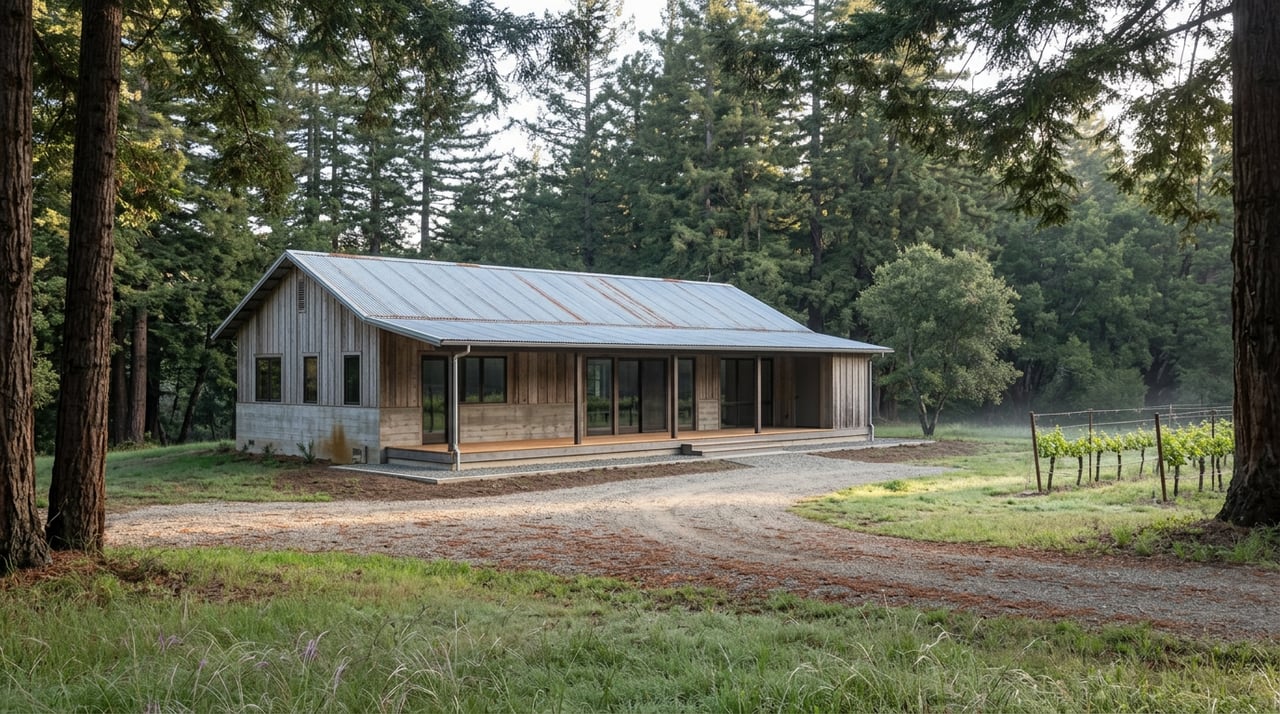
Read on its own, an 18 percent rebuild rate sounds like a community still stuck. Read against the pre-clearance bottleneck, it reads differently: the properties that have made it through are a distinct, smaller pool, and they're the ones now drawing renewed interest. The San Lorenzo Valley Post's five-year retrospective on Bonny Doon described homes that have finished rebuilding, often designed with fire-resistant materials like corrugated metal and concrete, now reaching the market and attracting buyers to a community that had spent years watching longtime neighbors relocate.
That's the practical takeaway for anyone comparing land here to other Santa Cruz Mountains options. A cleared, rebuilt, or clearance-complete Bonny Doon property isn't competing against every vacant parcel with similar acreage. It's competing against a much smaller set of properties that have already absorbed the cost and time the uncleared parcels haven't.
| Uncleared parcel | Clearance-complete or rebuilt property | |
|---|---|---|
| What's typically done | Acreage and rough boundaries only | Well tested and documented, septic/environmental health cleared, geologic hazard resolved |
| What to expect | Months of pre-application work before a permit application can even be filed | Faster path to permit, since the slowest steps are already behind it |
| Insurance path | Unknown until a full quote is run | Easier to evaluate against FAIR Plan hardening and Fire Risk Reduction credits |
Where This Leaves a Country-to-Coast Buyer
Bonny Doon still offers what draws people to it in the first place: private wells, dark skies, and land that borders working vineyards like Beauregard Vineyards off Pine Flat Road, alongside protected terrain in the Bonny Doon Ecological Reserve and the San Vicente Redwoods open space along San Vicente Creek. None of that has changed. What has changed is that evaluating a parcel here now requires reading past the listing sheet into two things a sale price can't show you: how far a property has actually gotten through pre-clearance, and where it stands with an insurer. Getting that reading right before an offer, not after, is the difference between a smooth escrow and a year of open questions.
A Few Questions Worth Asking
Does every Bonny Doon property automatically qualify for the new Fire Risk Reduction Community discount? No. The designation makes a property eligible for insurers to consider, but discount amounts and qualification vary by carrier and by the specific property's defensible space and construction. Confirm directly with an insurance provider.
If a lot already has a completed geologic hazard clearance, does that transfer to a new owner? The clearance is tied to the property, not the seller, so a completed clearance generally benefits whoever owns the parcel next. Confirm the clearance is current and request the documentation as part of due diligence.
Is the FAIR Plan the only coverage option for a Bonny Doon property? Not necessarily. Some properties, particularly those with completed fire hardening and a Fire Risk Reduction Community or Firewise USA designation, may qualify for standard-market coverage or FAIR Plan discounts. It depends on the individual property and carrier appetite, which is worth checking before you're under contract, not after.
Land and legacy properties in Santa Cruz County reward the buyer who asks the right questions early. If you're weighing a Bonny Doon parcel against other country options across the county, Kathleen Manning has spent years walking clients through exactly this kind of due diligence. Let's Connect.